
Truffle Dogs: What Really Drives Their Sense of Smell? Science vs. Myth
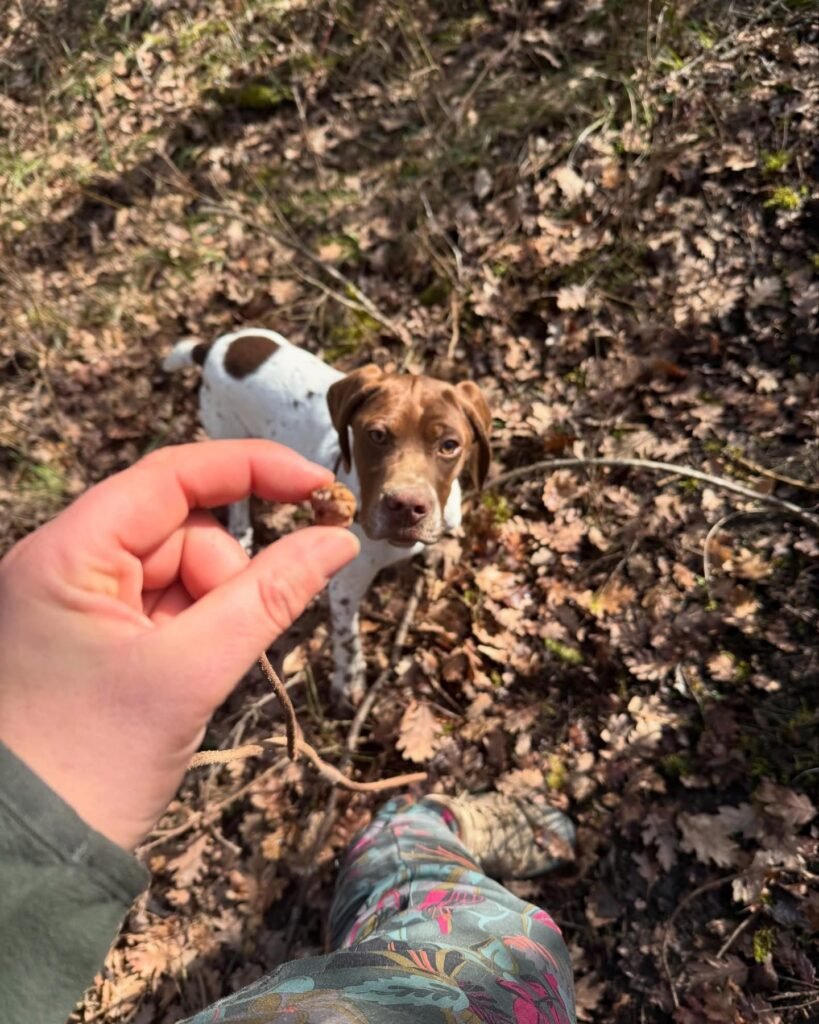
The world of truffle hunting is often shrouded in mystery. Between stories passed down through generations and traditional lore, it is easy to lose sight of the biological reality. But what actually guides a dog’s nose during a search?
Beyond the Myth: The Biology of Olfaction
There is a common belief that certain dogs are born with a “magic” talent. Science, however, points to a different reality. A dog’s success in truffle hunting does not depend on a supernatural gift, but on a combination of two factors: anatomy and structured conditioning.
The canine olfactory bulb occupies a proportionally much larger area of the brain than in humans. When a dog searches for a truffle, they are not performing a random act; they are conducting a complex biochemical analysis. They identify volatile molecules emitted by the hypogeal fungus, distinguish them from the myriad of other scents in the undergrowth (leaves, roots, humidity), and follow the scent trail back to its source.
Science vs. Popular Belief
Let’s dismantle two of the most common myths in the industry:
Myth: “Only specific breeds can have a good nose.”
Science: While certain breeds possess anatomical predispositions (such as longer muzzles or a higher density of scent receptors), the ability to scent-track is present in almost every canine. The true differentiator is motivation and early exposure to olfactory stimuli.
Myth: “You must let the dog taste the truffle to teach them to find it.”
Science: Learning does not happen through taste, but through association. The dog does not seek the truffle because they want to eat it; they seek it because their training has taught them that the specific scent of a truffle is the precursor to a reward (a game or food). The truffle is simply the signal that indicates a reward is forthcoming.
The Handler’s Role: The Engine of the Search
Many believe the dog does all the work alone. In reality, the handler-dog partnership is essential. While the dog interprets the olfactory data, the handler must be able to read the dog’s body language: subtle changes in pace, head position, and how the dog navigates wind currents.
The difference between an amateur and a professional lies in the ability to support the dog during difficult segments of the search without interfering with their cognitive process.
Optimizing Search: The Context Matters
For a dog to express their maximum potential, the work environment must be managed. A dog that is fatigued or over-excited loses the ability to discriminate odors accurately. Truffle hunting requires deep mental concentration; if the dog experiences the search as a source of stress, their efficiency will drop drastically.
The most effective approach treats the search as a problem-solving activity. The truffle is the “puzzle” that the dog loves to solve to fulfill their natural, ancestral drives.