Truffles and the Environment: The Role of the Dog in Sustainability
Truffle hunting is an ancient tradition, but in the modern world, sustainability has become an absolute priority.
We often discuss regulations, harvesting seasons, and land conservation, yet we rarely emphasize the fundamental role that the dog plays in protecting the forest ecosystem.
A truffle dog is not merely a search tool; it is a guardian of the forest’s integrity.
Environmental Impact: The Delicate Balance of the Mycelium
To understand the value of sustainability, we must analyze what happens beneath our feet. A truffle is not an isolated fruit; it is the reproductive part of a fungus that lives in symbiosis with tree roots, forming a network called mycelium.
The use of heavy spades, picks, or rakes—still unfortunately common among non-professional foragers—is devastating to this underground network. The mechanical destruction of the mycelium not only ruins the current season’s production but can sterilize the soil for years. Dogs, conversely, act with surgical precision:
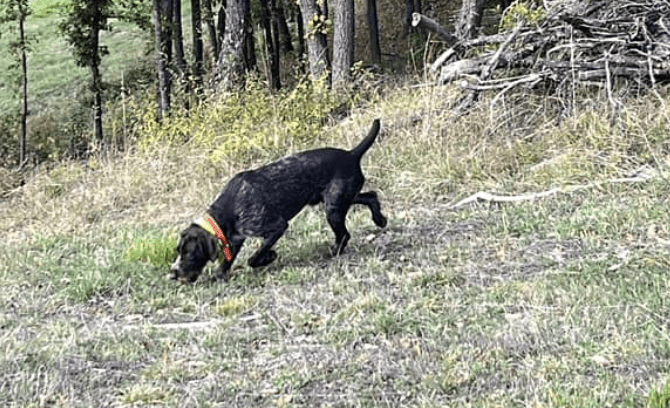
Targeted Identification: Thanks to their keen sense of smell, dogs identify the exact spot, allowing the handler to dig only where maturation is certain.
Ecosystem Energy Conservation: By avoiding unnecessary digging in areas where truffles are absent or unripe, the dog allows the mycelium to continue its vital nutrient exchange with tree roots.
Erosion Minimization: The less soil that is displaced, the less susceptible the ground is to rain erosion, thereby protecting the micro-fauna of the subsoil.
The Ethos of the “Responsible Forager”
Sustainability depends not only on the animal but on the ethics of the handler. An “ethical forager” is defined by a deep awareness of their ecological footprint:
Respecting Natural Cycles: Strictly adhering to regional harvest calendars is a duty. Harvesting an immature truffle prevents spore dispersal and condemns the mycelium to an interrupted production cycle.
Digging Technique: Extraction must occur exclusively with a specialized “vanghetto” (a small blade tool). It is mandatory to refill the hole with the removed soil. This is not merely for aesthetics; it protects the mycelium from sudden desiccation and prevents pathogens from attacking the exposed fungal network.
Animal Welfare Management: An over-fatigued dog loses focus, begins digging imprecisely, and becomes a potential threat to the soil. Sustainability also involves caring for the athlete: constant hydration, adequate rest, and respecting the dog’s physical limits are the pillars of professionalism.
The Dog as a Sentinel of Biodiversity
Beyond harvesting, dogs that regularly frequent the forest become true observers of environmental health. An attentive handler learns to read the dog not just when it is hunting for truffles, but when it interacts with the surrounding environment. Signs of soil degradation, the presence of invasive species, or changes in vegetation are often perceived by the dog long before they become evident to the human eye.
Integrating truffle hunting with an ecological vision transforms an economic activity into an act of environmental stewardship. If we love the forest, our dog must be our primary ally in preserving it, acting as a resource rather than a predator.